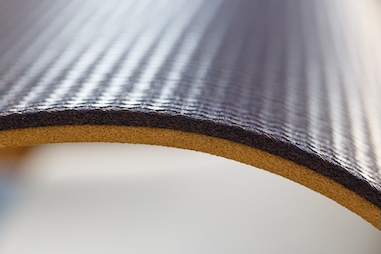
Heat lamination is a process for producing multi-layer products (these are called laminates), this allows us to combine the properties of the layers.
In case of PE foam we use only heat and some pressure to bond the two surfaces together, it means that no additional material is necessary. This is only possible if the two materials are „a bit similar” to each other chemically. If the material is too sensitive to heat (for example non-crosslinked PE foam or PS foam), we can’t process it this way.
Materials that we can laminate to our foam with heat lamination:
We can simulate lamination in our laboratory and test the new materials, so if you have something in mind that is not on this list, we can test it and give you feedback or recommendation for alternatives.
Heat lamination can be a continuous process, but a batch process too. For the continuous process around 20 mm is the maximum thickness that is possible. With the batch process it is possible to laminate lots and lots of layers on each other, so for example we can produce foam blocks with up to 500 mm thickness.
Embossing is a process where we give the surface of the foam or laminated surface a 3D texture. For this we need to press an engraved roll (with the negative version of the desired pattern) into surface of the foam or laminate. This surface has to be heated to a temperature where it becomes shapeable, so the engraved roll can give it a new shape.
Embossing can give the foam or laminated surface a unique, eye-catching look and a new hand feel, it can be a very important design aspect of a product, and the right kind of embossing can improve the anti-slip property of the surface too. Trocellen has a wide variety of engraved rolls, so we can offer you patterns developed by us, or it is also possible to develop a new pattern if there is need for that.
The limitation of embossing is the possible depth of the patterns that are achievable, it is roughly 1,5-2 mm.
During thermopressing the foam is heated on both the top and the bottom side, then pressed from both directions by a cooled two-part mold, and then released. It is possible to make foldable products with it, or to give very deep patterns to the surface.
The main difference between embossing and thermopressing is that with thermopressing the heating and cooling takes more time, but because of the more thorough heating, much deeper patterns are achievable than with embossing. This also means that thermopressing is a slower process.
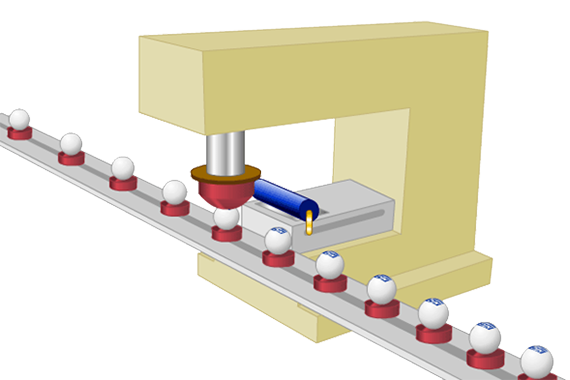
During this process we heat up an aluminum or steel tool to a degree where it burns the requested logo or text into the surface of the product. It is very similar to the “billog” procedure.
It is similar to the embossing process but here we use a flat tool. This way it is possible to put date indicators and future modifications (updates) of the tool are also possible easy.
Laser marking is a permanent process that uses a beam of concentrated light to create a lasting mark on a surface. Typically performed with a fiber, pulsed, continuous wave, green, or UV laser machine, laser marking encompasses a wide variety of applications. We use fiber laser technology to put logos into our products.

Laser marking is a permanent process that uses a beam of concentrated light to create a lasting mark on a surface. Typically performed with a fiber, pulsed, continuous wave, green, or UV laser machine, laser marking encompasses a wide variety of applications. We use fiber laser technology to put logos into our products.

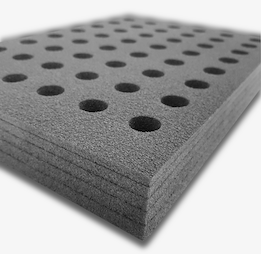
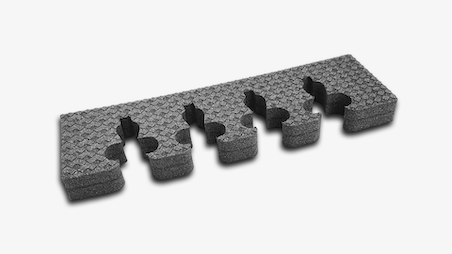
With this process we use a high pressure machine and sharp steel knives to cut out the product. We are capable of die cutting material up to 40mm (depending on the density).

For products with bigger thickness (higher than 40mm) we offer our contour cut service. Main advantage is the very clean cutting surface and the multi-layer cutting possibility in order to “cut your costs” as well. Limitation if this technology is that it only cuts the outer edge (contour) of the design. Without leaving a trace it is not possible to cut material from inside the product.